SANITIZING THE CLASSICS. Cleaning up Huckleberry Finn
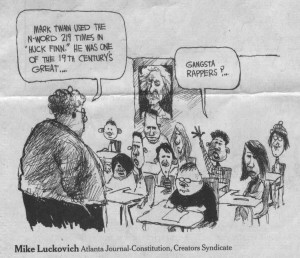 Aside from ethical and political considerations, Alan Gribben’s endeavor to retrofit “Huckleberry Finn,” (NewSouth Press) by changing the word “nigger” to “slavery” (219 times), “half-breed” to “half-blood,” and Injun” to “Indian,” possess literary issues as well. “Although the text loses some of the caustic sting that the n-word carries,” he professes, “ that price seems small compared to the revolting effect that the more offensive word has on contemporary readers.” His readership, by the way, includes college and graduate students.
“The word ‘nigger’ should sting,” writes author David Matthews, “It’s part of the bloodied soil of America, yet another legacy of slavery still with us a hundred-plus years after the fact . . . Modern readers are already too comfortable. Lazy, even. If the word ‘nigger’ keeps one from reading Huck Finn, then one lacks the critical skills to appreciate all the book has to offer.” Those critical skills all too often originate in the classroom. If at all.
Author Jane Smiley: “I would want my students to be shocked and repelled by the use of the n-word, and I would then want to discuss the issues around that word, and how those issues are represented in the novel. . . the word is intentionally loaded. “Slave” doesn’t carry the same shock value, and so it tones down what Twain is getting at.”
Writers’ words set the tone for their works. Not only numbing the shock charge, but the substitution of “slave” changes the context. The swap is an affront to the development of the lead character. “Dumbing and numbing down ‘Nigger Jim’ to ‘Slave Jim’ etiolates the crushing, dehumanizing institutional forces against the character, and minimizes Huck’s enlightenment.” (Matthews) English Professor Thomas Glave, draws attention to the literary misnomer that “Huck simply would not have referred to Jim as ‘slave.’ ” Novelist, Francine Prose, alleges, “ ‘Nigger’ and ‘slave’ are not synonyms by any stretch of the imagination. Jim’s problem is not that he is called a ‘nigger’ but that he is chattel who can be freed or returned to his master.” David Matthews agrees: “There is no equivalency between slave and ‘nigger,’ which is an American invention. It’s a word that denies humanity, and along with it justice and mercy.”
Psychology professor Timothy Jay reminds us “. . .it’s naïve to believe that anyone who is old enough to read ‘Huckleberry Finn’ would not know the racial epithet or why it’s offensive. “It is the persistence of racism in America that makes the n-word in Huck Finn a problem in the classroom,” concludes Professor Shelly Fisher Fishkin. “We need to give teachers the tools they need to teach Twain’s book in the context of the history of racism in this country that is its central concern.” Author Gish Jen adds: “The reader’s failure is not remedied by changes to the text; it is remedied by education and its happy result, perspective.”
Francine Prose offers a starting point: “The understandable discomfort the word ‘nigger’ causes students and teachers is part of a conversation; part of the point of reading that book in school is to have that conversation.” Which Timothy Jay sees a “teachable moment.” “Inform and prepare children to make their own decisions about information.” What may appear as offensive needs “to be confronted rather than tucked away. . . Censoring a word fails to address deeper problems with racism in our society. “Huckleberry Finn” is a classic that can provide a kind of “teachable moment” for children if we are willing to deal with it openly And, “If students recoil—well, perhaps that is an educational opportunity, too, for both those who recoil and those who don’t.” (Jane Smiley)
Endnote: “Substituting the word ‘slave’. . . suggests that understanding the truth of the past corrupts modern readers, when, in fact, this new edition is busy corrupting the past. (NYTimes)