NARCISSISM. Stealing a Look into the Unconscious
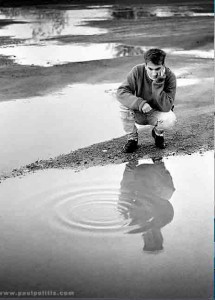
© Paul Politis
The term Narcissism got a bad rap from the beginning when Freud published his classical paper on the subject in 1915. Since then Narcissism has crept into the mainstream. NY Times writer Benedict Carey depicts “a devastatingly vulnerable person, compensating for a deeply imprinted inadequacy with a desperate need for admiration, and a grandiose self image.” Freud, however, saw Narcissism in two parts: primary, an instinct we all have for self-preservation, to nourish and protect ourselves from danger, and secondary, where the individual becomes self-centered and fixated with her or himself. Psychoanalysts introduced the concept of “inflation,” whereby the ego takes a fragment of itself to expand, while the remainder is denied—or unknown. This second state drew upon the Greek myth of Narcissus, where the thespian became obsessed with the image of beauty he saw in the water, not realizing that it was of himself. Yet, somehow this self-love notion took hold, gained momentum, culminating as the “Me-generation”—eventually getting into the shrink’s nomenclature as “narcisstic personality disorder.” Now, Mr Carey informs us that the American Psychiatric Association is considering dropping that diagnosis altogether.
Which is a fitting opportunity to relook at the old concept in a new light. Returning to Freud’s primary state, love of oneself is believed a necessary condition to love another. Revisiting the Greek legend, Narcissus loves what he sees in the stranger as beauty, but doesn’t realize that it is himself. Now in the Roman version of the myth, the youth is peering into the water, generally acknowledged as symbolic of the unconscious, in an attempt to better understand himself.
If we see Narcissus’s gaze at his own reflection as stealing a look into the unconscious and finding oneself, how then, does one realize the fulfillment of self-love? Perhaps it begins with self-knowledge gained through these observations—then engaging in a dialogue with oneself. This union is what the reflection in the water irresistibly drew Narcissus to. Through the encounter with the unconscious, the birth of the ego, in turn, makes way for the emergence of the Self—with Narcissism serving as a facilitator rather than an upshot.
The eminent mythologist, Joseph Campbell, reminds us that looking in the pool is a requisite step toward self-recognition—not an end—in the psyche’s development. “The aim is not to see, but to realize that one is, that essence; then one is free to wander as that essence in the world. Furthermore: the world too is of that essence. The essence of oneself and the essence of the world: these two are one. . . Wherever the hero may wander, whatever he may do, he is ever in the presence of his own essence—for he has the perfected eye to see. ”